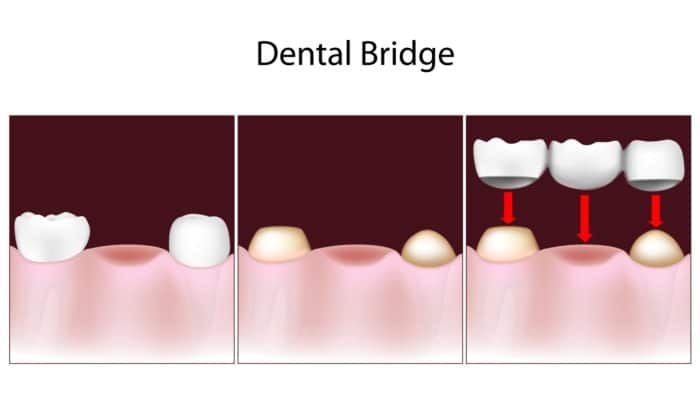
Dental crowns and bridges are very common procedures performed in the dental office. Their general purpose is to restore a tooth or teeth back to full chewing function. Crowns and bridges are different in many ways, and because bridges involve the use of crowns, we will describe a single crown first.
What is a Crown?
A crown, also referred to as a cap, is a dental restoration that covers the entire tooth, replacing its outer layer of enamel with a new material. A crown is contoured and sized similarly to a natural tooth, and they come into contact with the opposite tooth in a normal way, allowing for food to be chewed properly. In general, a crown should feel like a regular tooth when it comes to function. Depending on the material chosen for the crown, it also can look like a perfectly natural tooth.
What are Crowns Made From? Crowns can be fabricated out of many different materials, including plastic, various metals, porcelain, or a combination of these. The different materials serve different purposes and offer several advantages and disadvantages, as outlined by the chart below.
Crown type Commonly used for :
Plastic Temporary crowns while permanent crown is being made in a dental lab Very inexpensive Only last for a short period of time and cannot be a final restoration Full metal crown (typically yellow gold)Very back teeth that are short in height
Require least removal of tooth structure
High success rate over long term
Most resistance to decay
Metal appearance
Not cosmetically pleasing
High cost due to price of gold
Quick Appointment
[gravityform id="1" title="false"]
Porcelain fused to metal crownCan be used for any tooth in the mouth
Relatively natural appearance
Good long-term success
Strong
Can show dark shading at gumline where metal is visible
Appearance is opaque, unlike a natural tooth
Porcelain can fracture
Why do Teeth Need Crowns?
A tooth needs a crown when it no longer is strong enough to withstand normal chewing function on its own. There are multiple reasons a tooth could require a crown to function properly:
Large decay – If a tooth has a large cavity, which has destroyed its enamel and dentin (the core structure of teeth), it will be too weak to hold a filling and chew properly. By removing the cavity, building it back up, and covering it with a crown, the tooth will be able to do its job again.
Large fillings – If a tooth already has a large filling that covers more than half of the tooth, the remaining tooth structure is too weak to withstand chewing forces for the rest of the tooth’s lifespan. By covering it with a crown, the tooth is given a better long-term prognosis.
Cracks – Tooth cracks are a very complicated diagnosis and could be the subject of an entire article on their own. For a tooth crack with a limited extent (meaning it does not extend into the nerve inside the tooth or down the root underneath the gums), a crown is the only way to keep the crack from progressively getting worse. Teeth are covered in a solid layer of enamel, which acts as a protective coating. If that layer of enamel is disrupted by a crack, it is no longer doing its job, and it must be removed and replaced. The crown functions as the new enamel, protectively covering the tooth just as the enamel did.
Root canal treatment – When a tooth has a root canal, the nerve and blood vessels are removed from the hollow chamber inside the tooth. This means there is no longer any nourishment to the tooth, and it quickly becomes dried out and brittle. This brittleness predisposes the tooth to cracking. Any tooth that has had a root canal needs to be covered in a crown to prevent it from cracking. Root canals are expensive, and it would be a shame to let one go to waste because the tooth was never covered and cracked, requiring it to be extracted.
What is a Bridge?
A bridge is a fixed partial denture: it is fixed (glued) to the teeth, it replaces some (not all) of the teeth, and it uses a fake tooth or teeth (denture) in the place of missing teeth.
A bridge is used to replace one or more missing teeth, when functioning teeth are available on both sides of the missing tooth.
The adjacent teeth, called retainers, are covered by the bridge in exactly the same manner as a crown covers a single tooth. The difference is that the bridge connects the crowns to a pontic (fake tooth replacement) in the missing tooth space.
In the case of one missing tooth, a bridge would be three units: one unit for each adjacent retainer tooth, and one for the pontic. Bridges can be made from all of the same materials listed above for crowns.
What are the Benefits of a Bridge?
A bridge is a quick way to replace 1-2 missing teeth. It does not require any surgery, and it is typically paid for by dental insurance as a covered benefit.
A bridge requires two visits to your dentist. During the first visit, the two adjacent teeth are prepared just as they would be for crowns. You may wear a temporary bridge or just two separate temporary crowns while the bridge is being made by a dental lab. At the second visit, the final bridge is fitted and cemented to the teeth.